Welcome to your pilot teacher orientation
Thank you for piloting this STEMcx lesson.
Your feedback will directly shape how this curriculum is refined and shared with other classrooms.This page gives you everything you need to get started quickly.
Your curriculum coordinator is Zyare Hill, She can be reached at this link. Please reach out to her is you have any questions during this process.
Teacher Participation & Stipend Information
Teachers who complete the pilot requirements will receive a stipend in appreciation for their time and feedback.
To receive the stipend, teachers must complete the following:
✔ Teach at least one full unit (5 lessons)
✔ Use the provided materials (video, book, activity)
✔ Submit the teacher feedback form (with in one day of teaching unit)
✔ Submit a completed W-9 form.Stipend Amount: $500 per unit
Payment Method: Check /PayPal (preferred)
Payment Timeline: Within 1 week of completion
5 minute Lesson prep
Watch (Before Teaching): Choose Video below for the Lesson you are teaching
Read (Day 1) : You should have already received the Companion book for the lesson you chose. If not, please contact the Curriculum Coordinator.
Know the Goal - Depending on lessons
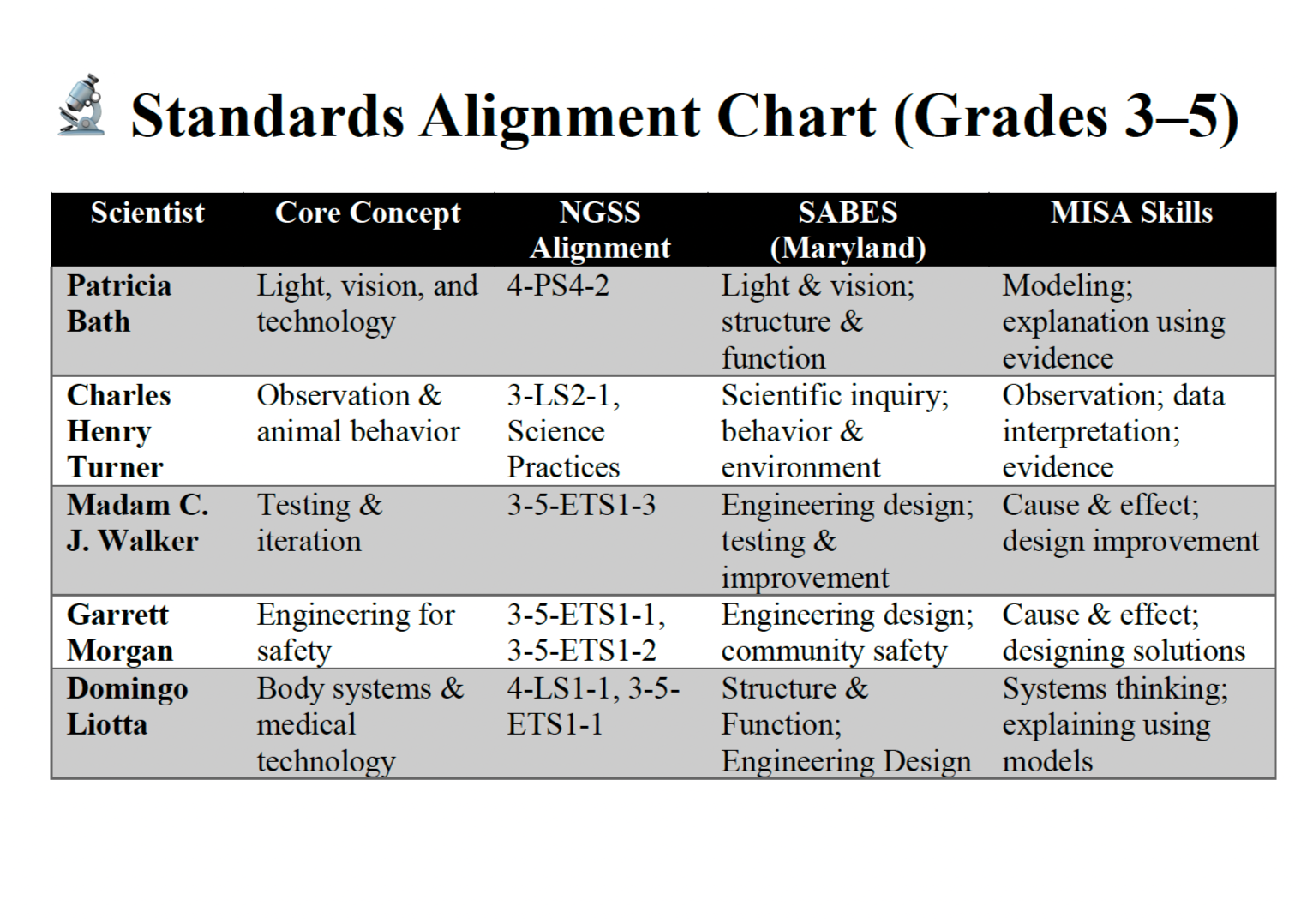
Patricia Bath: Students will explain how light helps us see, how the eye works as a system, and how technology can improve vision. (4-PS4-2 + systems thinking)
Charles Henry Turner; Students will use observation and evidence to explain animal behavior and how scientists learn from experiments. (Science Practices + LS standards
Madam C. J. Walker: Students will design, test, and improve a product and explain how iteration leads to better solutions. (ETS1-3)
Garrett Morgan: Students will design a solution to improve safety and explain how inventions can protect people in a community.(ETS1 + cause/effect)
Core Activity (Day 3)
Each unit includes a hands-on activity where students build, model, or design to deepen understanding.(LINK TO ACTIVITY FROM SCIENTIST NAME)
Patricia Bath: Build a model eye and explain how light travels through the system
Garrett Morgan: Build a traffic light model to understand safety systems
Charles Henry Turner: Conduct observations and simple experiments to study animal behavior
Madam C. J. Walker: Design and test a product to improve your design.
DR. PATRICA BATH
CHARLES HENRY TURNER
What does success look like?
👁️ Patricia Bath
✔ Explain how light helps us see
✔ Describe how parts of the eye work together
✔ Explain how technology improves vision
✔ Use evidence to support explanations
🐝 Charles Henry Turner
✔ Describe animal behavior using examples
✔ Use observation as evidence
✔ Explain how scientists learn through experiments
✔ Support thinking using evidence
💇🏾♀️ Madam C. J. Walker
✔ Design and test a product or solution
✔ Explain how testing improves results
✔ Describe how changes make a product better
✔ Use evidence to explain thinking
🚦 Garrett Morgan
✔ Explain how a traffic signal improves safety
✔ Describe the problem the invention solved
✔ Explain how inventions help communities
✔ Use cause and effect to explain thinking
Domingo Liotta
✔ Explain how body systems work together
✔ Describe what happens when a system fails
✔ Explain how medical technology helps the body
✔ Use evidence to support explanations
Feedback Form
Completion Checklist
☐ Teach the unit
☐ Submit feedback
☐ Upload W-9 (at completion of feedback from)